
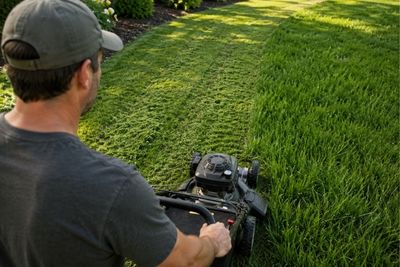
Your lawn gives you clues every time you mow. Here’s what to watch and listen for.
Most of us can tell when a lawn looks good after we’re finished mowing. Clean edges. An even cut. Maybe a few nice stripes.
But some of the most useful things your lawn can tell you happen while you’re mowing it.
A regular mow puts you closer to your lawn than almost anything else you do to it. You’re covering nearly every part of the yard, seeing it from different angles and feeling how the mower responds as conditions change.
Pay attention, and an ordinary mow can become a pretty good lawn inspection.
Here are seven things worth noticing.
1. Listen to the Mower
If you mow regularly, you probably know the normal sound of your mower without thinking about it.
That’s why a change in sound is worth noticing.
If the engine begins working harder in one section of the yard, the grass there may simply be taller or thicker. It could also be holding more moisture than the rest of the lawn.
Rather than automatically pushing through at the same pace, slow down and take a look. The mower may be telling you that conditions have changed before you’ve even noticed them visually.
2. Look at What’s Coming Out of the Deck
Grass clippings can tell you quite a bit.
Light, evenly dispersed clippings usually disappear quickly back into the lawn. Heavy piles or clumps deserve a second look.
The grass may be wet. It may have grown more than expected since the previous mow. Or you may simply be trying to remove too much at once.
Whatever the reason, don’t ignore what your mower leaves behind. Clumps of wet or heavy grass can sit on top of the turf and block sunlight from reaching the grass underneath.
3. Watch the Grass After the Mower Passes
Take an occasional look behind you.
A healthy, clean cut should leave the lawn looking relatively even. If the tips of the grass look torn, ragged or whitish after mowing, the grass may not be getting the clean cut you want.
That can be a sign that your mower blades need attention.
It can also be a reminder that the condition of the mower matters just as much as the mowing technique. A lawn can only look as good as the cut you’re giving it.
4. Notice Where the Grass Changes
One of the easiest things to spot from the mower seat is inconsistency.
Maybe one section is growing faster than everything around it. Another area may look thin. A patch near a tree may stay greener, while an exposed section is beginning to fade.
Those differences aren’t necessarily problems. Lawns rarely grow exactly the same everywhere.
Sunlight, shade, moisture, soil conditions, traffic and drainage can all vary within a single yard.
The important part is noticing when something changes.
If an area that normally grows well suddenly isn’t, that’s worth watching.
5. Pay Attention to How the Lawn Responds to Your Tires
Your mower tires can provide another clue, particularly during hot or dry weather.
If the grass springs back relatively quickly after you pass over it, that’s one thing. If tire tracks remain obvious and the grass stays flattened, the lawn may be under stress.
That doesn’t automatically mean something is wrong. But combined with slower growth, dry soil or fading color, persistent tracks can be another reason to reconsider whether the lawn really needs to be mowed again just yet.
Sometimes the best mowing decision is giving the grass a little more time.
6. Watch for Things That Weren’t There Last Time
Mowing gives you a front-row view of changes that are easy to miss from the porch.
A new patch of weeds.
A bare spot.
An area damaged by traffic.
A low spot that’s holding water.
A section of grass that’s suddenly a different color.
You don’t have to diagnose every change immediately. In fact, watching an area for another week can sometimes tell you more than reacting to it right away.
The advantage is simply that you’ve noticed it early.
7. Pay Attention to the Overall Feel of the Mow
Experienced mowers often know when something just feels different.
The lawn is taking longer to cut.
The mower is working harder.
There are more clippings than usual.
The ground feels softer.
The grass isn’t standing up the way it normally does.
No single one of those observations necessarily means much by itself. Together, though, they can tell you that conditions have changed and your normal mowing routine might need to change with them.
That’s one reason a rigid mowing schedule doesn’t always make sense.
Your lawn doesn’t know it’s Saturday.
A Better Mow Starts With Paying Attention
You don’t need to become a turf expert to learn something from your lawn.
You just need to notice it.
Listen to the mower. Look at the clippings. Watch how the grass responds. Remember the spots that look different from the week before.
Over time, you’ll begin recognizing what’s normal for your own lawn and what isn’t.
And that’s one of the benefits of spending time behind a mower that doesn’t get talked about very often.
You’re not just cutting the grass.
You’re getting to know your lawn.