
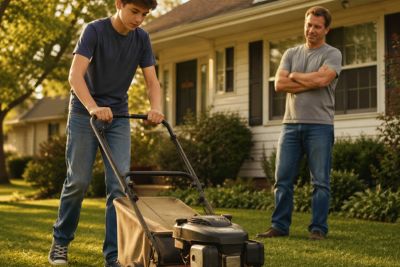
For many people, mowing the lawn was more than a chore. It was one of the first real responsibilities we were trusted to handle.
Maybe it was a parent walking beside you for the first few passes. Maybe it was an older sibling showing you how to start the mower. Maybe it was the feeling of being handed the job and realizing someone believed you could do it.
There was pride in that moment.
Long before apps, notifications, and endless distractions, mowing the lawn taught lessons that still matter today. It also remains one of the best ways to learn how a healthy lawn really works.
The Lawn Never Needed Perfection
One of the first things many people learned is that lawns do not need perfection to look good.
Your lines may have been crooked. You may have missed a patch near the mailbox. You may have left a little extra grass around a tree.
But once the job was finished, the yard looked cared for. And that matters more than perfection ever will.
Today, many homeowners overthink lawn care. They assume every pass must be flawless or every weed must disappear immediately. In reality, consistency usually wins.
Regular mowing, reasonable care, and attention over time will outperform occasional bursts of perfectionism.
Lesson One: Don’t Cut Too Much at Once
Many first-time mowers learned quickly that letting grass get too tall creates more work.
Tall grass clumps. It bogs down the mower. It leaves messy rows and uneven cuts.
That lesson still matters. A good rule is to avoid removing more than one-third of the grass blade in a single mowing. Cutting too much at once can stress the lawn and weaken healthy growth.
If the lawn has gotten away from you, raise the deck height for the first pass and lower it gradually over the next mow or two.
Patience is often better than scalping.
Lesson Two: Sharp Blades Make a Big Difference
Most beginners notice that sometimes the lawn looks clean after mowing, and sometimes it looks rough.
Often the difference is the mower blade.
A sharp blade slices grass cleanly. A dull blade tears it. Torn grass tips can look brown or ragged and may leave the lawn looking stressed.
If your lawn never seems to have that fresh-cut look for long, the blade may be the reason.
Sharpening or replacing mower blades as needed is one of the simplest upgrades in lawn care.
Lesson Three: Slow Down
Many of us tried to mow too fast when we first started.
Fast mowing feels efficient, but it usually leads to missed strips, uneven cuts, poor trimming, and more time spent fixing mistakes.
A steady pace gives the mower time to cut properly and allows you to notice obstacles, soft spots, toys, sticks, or hidden debris.
Good mowing often looks unhurried.
Lesson Four: Mow High More Often
Older generations sometimes knew this instinctively, even if they never used the phrase “turf science.”
Grass kept slightly taller often handles summer stress better. Taller grass shades the soil, helps roots grow deeper, and can reduce weed pressure.
That means many lawns benefit from mowing higher than people think, especially during hot weather.
Short grass may look neat for a day. Healthy grass looks better for weeks.
Lesson Five: Finish What You Start
There was something satisfying about finishing the entire yard.
Front yard. Back yard. Around the trees. Along the fence. Done.
That same mindset still helps today. Half-finished mowing jobs, skipped edges, and “I’ll get it later” trimming often make a lawn feel untidy even when most of the grass is cut.
Sometimes the last ten minutes matter most.
The Quiet Value of Lawn Responsibility
Mowing also taught something deeper.
You learned to notice weather. You learned timing. You learned that maintenance done regularly is easier than repairs done late. You learned pride in visible work.
Those lessons transfer far beyond the yard.
Even now, many people say mowing clears their head. It offers simple progress in a complicated world. You start with an overgrown lawn and finish with order.
That feeling never really gets old.
If Someone Is Learning Today
If you are teaching teenager or first-time homeowner to mow now, keep it simple:
- Start with safety first
- Show how to check the area for sticks, rocks, and toys
- Explain mower height settings
- Demonstrate turning and overlapping passes
- Encourage steady pace over speed
- Focus on doing the job well, not perfectly
- Let them take pride in the result
The first mow is rarely perfect.
It is memorable.
Final Thought
Many of us remember our first time mowing because it marked the beginning of something small but meaningful: responsibility, pride, and the satisfaction of useful work.
And decades later, the same lawn still rewards the same habits.
Show up. Stay steady. Do the next pass well.